You’ve used your air mattress for guests, camping, or temporary sleeping. Now it’s time to pack it away. Knowing how to deflate an air mattress properly keeps it in good condition, prevents mold, and ensures it fits back into its storage bag. A poorly deflated mattress can develop permanent creases, weaken seams, or trap moisture, shortening its lifespan. This guide walks you through every step from opening the valve correctly to rolling it tightly for storage.
Open the Valve Correctly
Before any air escapes, you must unlock the mattress airtight seal by opening the valve. This small component controls airflow and varies by brand and model.
Identify Your Valve Type
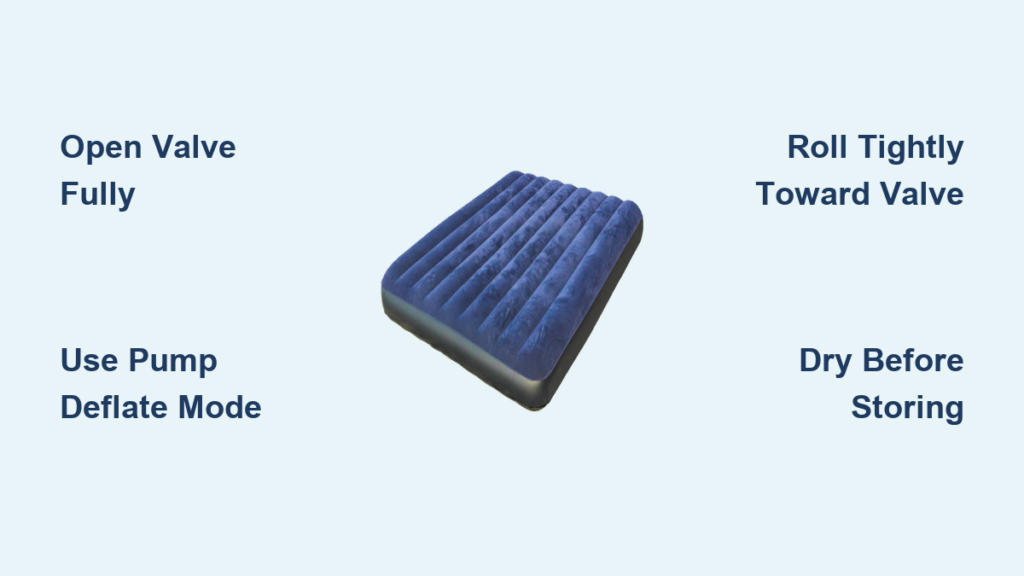
Different valves require different handling. Twist valves turn counterclockwise until loose, common on Intex and standard models. Spring-loaded valves press down or pull up to release, with some auto-opening when pressure drops. Double-lock valves have two layers that both need disengaging before deflation. CPR or quick-release valves are found on medical beds and should only be used in emergencies.
Check your mattress side or end to locate the valve. Some dual-chamber models have multiple valves, one per chamber. Open every valve to ensure complete, even deflation.
Fully Engage the Release Mechanism
Partial opening traps air inside. For twist valves, rotate until you feel it click or loosen completely. With spring valves, press and hold if needed. Never force it, as excessive pressure can damage internal seals. Once open, you should hear a soft hiss as air begins to escape.
Clean debris from the valve before opening. Dust or fabric fibers can block airflow or prevent resealing later.
Use a Pump With Deflate Mode

The fastest and most efficient way to deflate is with a pump that reverses airflow. This method removes up to 95 to 100 percent of air in minutes.
Choose the Right Pump
Not all pumps deflate. Look for models labeled dual-action, reverse mode, or suction. AC-powered pumps like the Coleman QuickPump are best for home use and deflate queen size in 4 to 6 minutes. Rechargeable pumps like the Aerogogo GIGA PUMP are portable and ideal for camping. Built-in electric pumps deflate at the press of a button, with many auto-shutoff when done.
Avoid single-action pumps that only inflate.
Connect and Activate Suction
Set the pump to deflate mode using the switch or button. Insert the nozzle firmly into the open valve. Use duct tape or an adapter if the fit is not snug. Power on the pump and air will be actively pulled out. Assist by pressing hands or knees across the surface to release trapped pockets.
Wait until no more air flows and the mattress lies flat, typically 2 to 8 minutes depending on size and pump strength.
Do not leave the pump unattended. Some low-end pumps overheat if run too long.
Roll From Far End to Valve
When no pump is available, rolling is the most effective manual method. It uses physical pressure to push air toward the open valve.
Start at the Opposite End
Begin at the foot or head, whichever is farthest from the valve. This ensures air has a clear path out. Kneel or stand on that end and press down firmly.
Roll Tightly and Evenly
Use your body weight to roll toward the valve in smooth, overlapping motions, like squeezing toothpaste from a tube. Keep the roll compact and avoid gaps. For queen or king sizes, two people help. One rolls while the other guides and presses ahead of the roll to force air forward.
Once fully rolled, hold pressure briefly to expel final air, then close the valve immediately.
Fold in Sections If Rolling Fails
If thickness or stiffness makes rolling difficult, folding works as an alternative, especially for thick or self-inflating camping mats.
Apply Pressure With Each Fold
Open the valve. Push air toward the valve by folding one end to the middle, pressing down hard. Fold the other end over it. Repeat into smaller sections, pressing after each fold.
This method creates sharper creases than rolling, so follow manufacturer instructions to avoid damaging internal layers.
Repeated sharp folds may weaken seams over time. Reserve this for occasional use.
Try a Vacuum Cleaner
/how-to-patch-an-air-mattress-51904431-04-ad7f400669294ac79a000b92ad244098.JPG)
No pump? A household vacuum can work in a pinch.
Seal the Hose to the Valve
Open the valve. Fit the vacuum hose snugly over it using duct tape, a rubber gasket, or a nozzle adaptor to prevent leaks. Turn on the vacuum, as suction draws air out. Massage the mattress with your hands to shift trapped air pockets.
Most home vacuums lack strong suction. This works best on twin or single sizes and is less effective on larger models.
Let Gravity Pull Air Out
For lightweight or partially deflated mattresses, gravity can assist without tools.
Lift and Tilt the Mattress
Open the valve. Lift the end opposite the valve straight up. Let air naturally flow toward and escape through the valve. Gently shake or press the base to encourage movement. Lower it once air stops flowing.
This method works best for thin guest or camping mattresses. It is not suitable for fast deflation.
Press Out Stubborn Air Pockets
Even after rolling or pumping, air often hides in corners or seams. Final manual pressure ensures full deflation.
Knead Like Dough
Use hands, elbows, or knees to apply firm, circular pressure, starting from the farthest point and moving toward the valve. Work systematically across the surface, especially along edges and under seams.
This step, also called coaxing air out, is crucial for achieving a tight roll and compact storage.
Close the Valve Securely
Once flat, seal the valve to protect against dust, moisture, and accidental reinflation.
Re-Engage Locking Mechanisms
For twist valves, turn clockwise until tight. For spring valves, push or twist back into closed position. For double-lock valves, re-secure both layers. Check that the seal feels firm.
A loose valve leads to slow reinflation or contamination during storage. The valve should sit flush and not wiggle.
Clean Before Storing
Storing a dirty mattress invites mold, mildew, and odors, especially after shared or medical use.
Wipe Down the Surface
Use a damp cloth with mild soap or disinfectant. Focus on high-contact areas like head and shoulder zones, seams and valve housing, and any visible stains or sweat marks. Rinse with a clean, damp cloth if needed.
For hospital-grade models, use EPA-approved disinfectants and follow CDC cleaning protocols.
Dry Completely
Air-dry the mattress fully, ideally overnight, in a well-ventilated, shaded area. Never store damp. Moisture trapped inside causes irreversible damage and foul smells.
Roll or Fold Properly for Storage
How you pack the mattress affects its longevity and ease of future use.
Roll (Preferred Method)
Rolling minimizes sharp creases, saves space, and maintains material integrity. Roll tightly but not excessively, as over-tightening strains inner layers. Use the original carry bag to maintain shape.
Fold (If Recommended)
Only fold if the manufacturer specifies it. Avoid folding in the same spots repeatedly.
A properly deflated queen-size mattress rolls down to under 20 inches wide and 6 to 8 inches thick.
Store in a Cool, Dry Place
Environment matters just as much as technique.
Avoid Extreme Conditions
Do not store in attics, garages, or basements, as temperature swings degrade materials. Keep away from sunlight, as UV rays weaken PVC and vinyl. Do not store near chemicals or sharp objects, as fumes and punctures ruin the mattress.
Use a protective storage bag to shield against dust, pests, and abrasion. Never store inflated or partially inflated, as this stresses seams and leads to permanent deformation.
Prevent Damage During Deflation
Even careful users make mistakes that shorten mattress life.
Avoid These Common Errors
Do not jump or stand on the mattress, as this can burst seams, especially on bariatric models. Do not use sharp tools like knives or scissors that risk punctures. Do not drag across floors, as this abrades the base layer. Do not sit on thin edges, as concentrated weight weakens side seams.
Deflate at room temperature. Cold air contracts, giving a false flat reading. The mattress may reinflate when warmed.
Model-Specific Tips

Different mattresses require unique handling.
Intex Air Mattress
Intex mattresses use standard twist valves that turn counterclockwise to open. The best methods are electric pump, rolling, or vacuum. Use the provided folding pattern and store in the original bag. Deflate fully after each use.
Hospital-Grade Mattress
Hospital-grade mattresses have electronic controls, multi-chamber design, and CPR valves. Power off the control unit first. Open all chamber valves. Use the CPR valve only in emergencies. Fold evenly and press out residual air. Two-person handling is recommended for heavy-duty models.
Self-Inflating Camping Mat
Self-inflating mats require no pump to inflate, but deflation requires effort. Open the valve fully. Roll from foot to head, compressing the foam core. Use body weight to squeeze air out. Store unrolled when not in use to preserve foam.
Built-in Pump Models
Models with built-in pumps offer one-touch deflation. Connect power and press the deflate button. Wait 4 to 8 minutes, as some models auto-stop. Close the valve manually if not automatic.
Some models include auto-shutoff to prevent overuse and save energy.
Choose the Best Deflation Tool
Your tool choice impacts speed, effort, and completeness.
Recommended Pumps
The Aerogogo GIGA PUMP works best for travel and camping, deflating a queen in 5 to 7 minutes with ultra-light USB-powered operation. The Flextail Portable Pump suits backpacking, taking 6 to 9 minutes with compact fast recharge. The Coleman QuickPump is ideal for home use, deflating in 4 to 6 minutes with high CFM durability. The Intex Quick-Fill Mini offers a budget option at 5 to 8 minutes. The Sea to Summit Ultralight fits in the palm for backpacking at 5 to 8 minutes.
Pumps with 15 to 25 CFM airflow deflate fastest.
Alternative Tools
A vacuum cleaner works with a good seal. A hairdryer is not usable, as it blows air in unless it has a rare reverse function. Manual pressure is always effective and requires no tools.
Maintain Long-Term Mattress Health
Proper deflation is part of a larger care routine that extends lifespan.
Inspect for Leaks Regularly
Before storing or reusing, inflate fully and close the valve. Monitor for 8 to 12 hours. If pressure drops, test with soapy water where bubbles show leaks. Repair immediately with a PVC patch kit.
Avoid Long-Term Inflation
Leaving a mattress inflated for weeks or months stresses materials. Even heavy-duty models should be deflated after each use. Some hospital beds are designed for continuous use, so follow medical guidelines.
Follow Temperature Guidelines
Air expands when warm and contracts when cold. Inflate and deflate at room temperature for accurate firmness and full air removal. Cold environments may require re-inflation after warming.
Frequently Asked Questions About Deflating an Air Mattress
Can I use a hairdryer to deflate my air mattress?
No. Standard hairdryers only blow air in. You need a reverse-air blower or vacuum cleaner to deflate a mattress.
Will folding help deflate the mattress faster?
Yes. Folding applies pressure and forces air toward the valve, accelerating the deflation process.
Can I leave the mattress inflated for a long time?
No. Prolonged inflation causes stress on seams and materials, reducing the mattress lifespan.
Do I need a special pump to deflate?
No. Manual methods like rolling work, but a pump with reverse mode is faster and more efficient.
Is it okay to sit on the mattress while deflating?
Yes. Gentle pressure helps expel air, especially during rolling or folding.
Can I use a vacuum cleaner to deflate my mattress?
Yes. Attach the hose securely to the valve and turn on suction. This works best with strong vacuums.
Key Takeaways for Deflating Your Air Mattress
Deflating an air mattress does not have to be a chore. With the right method, whether using an electric pump, rolling by hand, or using a vacuum, you can do it quickly and safely. Always start by opening the valve fully, remove air completely using pressure or suction, clean the surface, and store it dry and flat. Avoid common pitfalls like dragging, over-rolling, or storing damp. Whether it is an Intex guest bed, a medical air mattress, or a camping pad, proper deflation preserves performance and ensures it is ready when you need it next.